custom-llm
A tiny language model, built and taken apart
A 2-block, 4-head, 64-number nanoGPT — 122,368 parameters — trained from scratch on word tokens, then measured with a fixed 48-case exam it never saw in training, and finally opened up so you can watch it choose a word.
▶ Open the interactive explorer — the map of what the model thinks is related, a chat box that runs the real weights in your browser, and the arithmetic behind every prediction.
| Starter corpus | Expanded corpus | |
|---|---|---|
| 48-case exam, before training | 9/48 | 9/48 |
| 48-case exam, after training | 20/48 | 35/48 |
| Cases it could even read | 24/48 | 36/48 |
| Of the 12 cases I taught for | 0/12 | 11/12 |
| Of the 12 cases I deliberately did not teach | 0/12 | 0/12 |
The headline is not the score. It is that the gain is confined to exactly what I taught: the 12 control cases score zero in every run, before and after, in both experiments and at three different random seeds.
Contents
- In plain language
- What is in this repository
- The three choices
- The corpus for the extension
- What I predicted, and what actually happened
- The exam: all four result sets
- Is the improvement real?
- One case that fails, and why it is my fault
- How this thing actually learns
- Training curves and samples
- The interactive explorer
- Chat with the model
- Reproducing everything
- Limitations and the next experiment
- How this was built
In plain language
If you only read one section, read this one. The rest of the document is the evidence behind it.
This is a language model — the same kind of thing as ChatGPT, about a million times smaller. 122,368 numbers instead of hundreds of billions; half a megabyte instead of a data centre. The smallness is the point: at this size every part of it can be looked at, which is what the explorer is for.
It only ever does one thing: guess the next word. Show it
the team discussed the mango and the juice at the ___ and it produces a probability for every
word it knows. kitchen gets most of it. Everything a large model appears to do — answering,
reasoning, writing code — is this same operation at enormous scale.
It starts knowing nothing. Every word gets 64 random numbers attached to it, so at the
start surgeon is no closer to doctor than to banana. Training shows it sentences, asks it
to guess the next word, measures how wrong it was, and nudges all 122,368 numbers slightly
in the direction that would have been less wrong. Three thousand times. Nobody ever tells it
what a surgeon is — yet afterwards the five words nearest surgeon are physician, dentist,
therapist, doctor, nurse, worked out purely from which words kept appearing in the same
sentences. In the explorer’s map that is the difference between 0 connections before
training and 489 after.
Then it sits an exam it has never seen — 48 fill-in-the-blank questions, four options each. The absolute rule is that no exam question may appear in the study material, which is audited six ways.
The experiment asks one question: does adding study material actually teach it anything?
- With the standard starter textbook it scored 20/48 — and 24 of those questions it could not even read, because words like opposite and ice were not in its 133-word vocabulary. Unknown words are invisible to it, not approximated.
- Then study material was added for half of the topics it was failing — opposites, grammar, everyday facts, analogies — and deliberately none for the other half: negation, references, sequence, spatial relations.
- It scored 35/48. On the four topics taught: 0 → 11/12. On the four deliberately skipped: 0/12, unchanged.
That last line is the actual finding. The improvement lands exactly where the teaching landed and nowhere else, which is far stronger evidence than a rising score, because it rules out “the model simply got better at everything”.
Three things separate this from wishful thinking:
- Predictions were written down first, committed before training. Several were wrong, and they are still shown rather than quietly fixed.
- Every configuration was run at three random seeds. One apparent result — the transfer questions improving — turned out to happen by luck alone at one seed, so that claim was removed. That is the difference between a finding and a coincidence.
- A version was trained three times longer to test whether more training could substitute for more data. It could not: 34/48, no better. You cannot train your way into words the model has never seen.
One failure, explained exactly. Asked what water freezes into, it answers steam instead of
ice — because the study material contains the sentence ice melts into water, teaching it
that into is followed by water, in direct competition with the wanted answer. That is a data
problem, self-inflicted and traceable.
The honest ceiling. This model does not understand anything. Choosing the right word from
four, after being drilled on that pattern, is a very different skill from knowing what a surgeon
does — and its unassisted writing gives the game away: asked the opposite of empty is, the exam
scored it correct while its free-form reply was two . The tidy clusters in the map are a
picture of which words occurred near each other in a small synthetic corpus, not a map of
meaning.
What is in this repository
| Path | What it is |
|---|---|
custom_llm.ipynb |
Executed notebook, expanded-corpus experiment, outputs intact |
custom_llm_starter.ipynb |
Executed notebook, starter-corpus experiment |
PREDICTION.md |
What I expected, committed to git before the first training run |
make_corpus.py |
Generates my teaching corpus and withholds anything that collides with the exam |
corpus/ |
The teaching material: 3 Markdown files and 1 PDF, generated by make_corpus.py |
evals/language_evals.json |
The supplied 48-case exam, unchanged |
run_evals.py |
The supplied scorer: inference only, never trains |
results/ |
Every run: weights, corpus, eval results, losses, samples |
viz/ |
The interactive explorer, its data exporters and the in-browser model |
chat.py · chat_web.py |
Terminal and web chat interfaces |
build_readme.py |
Generates this file from the saved results |
Starter notebook, run_evals.py, chat.py, nanogpt_model.py, the eval suite and
embedding-viewer.html come from the course sample project
pepealonso95/custom-llm; the network itself is
Karpathy’s nanoGPT at the pinned commit
3adf61e154c3, hash-checked on every run (NANOGPT_LICENSE).
The three choices
| Choice | Value | Why |
|---|---|---|
| Corpus | Run 1: classroom sentences only. Run 2: the same plus 1,418 generated teaching passages | The corpus is the only difference between the two runs, so any change in the exam has one candidate cause |
| Training steps | 3,000 in both | The suggested budget, and validation loss is already flat there. Holding it identical matters more than tuning it: train run 2 longer and I could not tell new data from extra steps |
| Learning rate | 0.001 in both | The notebook default, with 100-step warmup and cosine decay to 10%. Much larger and AdamW’s steps overshoot — the loss oscillates or goes non-finite, which the notebook guards against. Much smaller and 3,000 steps end near the random start, with loss barely below ln(vocabulary) |
Everything else — seed 42, 2 blocks, 4 heads, 64 numbers per token, 48-token context, batch 32 — is the supplied default and identical across both runs.
The corpus for the extension
The starter corpus is synthetic classroom sentences. Its vocabulary has no word for opposite,
ice, robin or walked, so all 24 extension cases are unreadable to it: some word in the
prompt or in the four answers is outside the vocabulary, the case is marked
out_of_vocabulary, and it scores zero no matter how long you train.
So the extension corpus teaches four of the eight extension categories, and deliberately contains nothing for the other four:
| Taught | Left as a control |
|---|---|
grammar, opposites, everyday_knowledge, categories_and_analogies |
negation, reference, sequence, spatial_relations |
That makes the other 12 cases an internal control group: same model, same exam, same training run. If their scores moved, something other than my teaching material would be responsible.
What it contains
| File | Passages | Form |
|---|---|---|
corpus/grammar.md |
420 | Markdown |
corpus/opposites.md |
420 | Markdown |
corpus/everyday_knowledge.pdf |
252 | PDF, rendered from corpus_sources/everyday_knowledge.md |
corpus/categories_and_analogies.md |
329 | Markdown |
| Total | 1,421 (1,418 unique) | adds 200 distinct token types |
Provenance and permissions. None of this is third-party text. The passages are produced
programmatically by make_corpus.py from sentence templates and word lists
defined in that script, which was written for this assignment with AI assistance (see
How this was built). The experimental design the corpus serves — which
four categories to teach, which four to hold back as a control, and the decision to keep every
other setting fixed — is mine. No outside documents, no personal data, nothing confidential, and
nothing that requires anyone’s permission to share.
Keeping the exam out of the textbook
make_corpus.py generates freely and then withholds any line that reproduces a test prompt,
using the starter’s own matching rule — the same idea the notebook applies to its own generated
sentences. It reserved 61 lines, including every
the opposite of hot is cold, every one bird is … and every yesterday she ….
Two subtleties I had to handle, both visible in the code:
- The notebook checks an imported file as one continuous stream, not line by line. So
a carrot is a vegetable .on one line followed byan apple is a fruit .on the next reproduces a test prompt across the line break even though neither line does alone.order_lines()orders every file so no window of three consecutive lines contains a prompt, and the file-level check runs again before anything is written. chunk_textsplits on a sentence mark followed by whitespace, so every training passage is a single sentence and a file corpus cannot teach a two-clause pattern at all — which is what the analogy cases are. Writing the period glued to the next word (a duck is a bird .a goat is an animal .) keeps both clauses in one passage; the tokenizer matches words and single punctuation marks and ignores whitespace, so the training tokens are identical to the spaced version. 263 of my analogy passages use this, and the leakage check still runs on the joined passage exactly as the model sees it.
The separation audit
Leakage is the one thing in this assignment that can cost marks beyond its own category, so
verify_separation.py checks it from six directions and writes
separation_audit.json. Run it yourself with
python verify_separation.py.
| # | Check | Result |
|---|---|---|
| 1 | Eval prompts found in any training input (12 audited, across all 7 runs) | 0 |
| 2 | prompt + answer strings found in training text |
0 |
| 3 | Training lines holding 3+ choices from one case (a copied answer list) | 0 |
| 4 | Eval files, eval results or chat transcripts inside a corpus folder | 0 |
| 5 | Vocabulary built only from training passages | yes |
| 6 | Trained and untrained weights differ; one single suite hash across every run | yes |
The suite hash 1d7c503f34d88260d0ac897b… is identical in all 7 runs and in both stages of each, so
the same 48 cases, the same four choices and the same answer key scored everything. The scorer
run_evals.py only ever runs inference, and asserts the model’s hash is
unchanged afterwards — if scoring had nudged a single weight it would have raised.
What does overlap, and why that is allowed
The assignment is explicit that ordinary words and underlying subject knowledge may overlap; only the test items themselves must stay out. So the honest question is not “is there any overlap” but “how close does the training text get”. For 20 of the 48 cases, the last three words of the prompt are followed by the correct answer somewhere in training:
| Case | Category | Phrase in training text | Times |
|---|---|---|---|
lang_46 |
categories_and_analogies | …salmon is a fish |
31 |
lang_48 |
categories_and_analogies | …apple is a fruit |
27 |
lang_09 |
domain_place | …service at the store |
20 |
lang_10 |
domain_place | …quality at the market |
20 |
lang_11 |
domain_place | …payment at the bank |
20 |
lang_12 |
domain_place | …juice at the kitchen |
20 |
lang_13 |
domain_place | …journey at the station |
20 |
lang_14 |
domain_place | …security at the office |
20 |
lang_15 |
domain_place | …patient at the hospital |
20 |
lang_16 |
domain_place | …lesson at the school |
20 |
lang_47 |
categories_and_analogies | …grows into a cat |
11 |
lang_45 |
everyday_knowledge | …turn on a light |
7 |
Two worked examples of what is behind those counts:
lang_09— the test prefix isthe team discussed the customer and the service at the→ store. That exact sentence is not in the training text; the notebook reserved it, along with 159 other passages, before the split and before the vocabulary was built. What remains is its siblings with a different noun:the team discussed the client and the service at the store .This is the supplied corpus behaving as the assignment describes — it teaches the association and withholds the exact test sentence.lang_46— the test prefix isa robin is a bird . a salmon is a→ fish, and it is absent too. My analogy file does containa salmon is a fish ., paired with other first clauses:a banana is a fruit .a salmon is a fish .The fact is taught; the test item, with itsa robin is a birdopening, never appears.
That is the line the assignment draws, and it is also why the scores should be read as a development benchmark: I could see these cases while choosing what to teach.
Both runs’ separation records are saved:
eval_separation.json — the notebook reserved
160 classroom passages covering
16 test cases before the split and before the vocabulary
was built. Its method line says it plainly: “normalized contiguous prompt match; not a semantic leakage detector”. An exact-match
check cannot catch paraphrases, so the real guarantee is that the material is generated from a
script in this repository and can be read in full: make_corpus.py is 250
lines, and the passages it produces are committed alongside it.
The PDF, and what the extraction check caught
One file ships as a PDF on purpose, so the notebook’s PDF path is exercised rather than described. Rendering it went wrong twice, and both are worth recording:
- A per-page
<h2>header extracted as text and became six junk training passages. - At 46 lines per page the list overflowed the fixed page height and
overflow:hiddensilently dropped 5 teaching sentences. Nothing warned: every page still had text, so the notebook’s “no text extracted” warning would never have fired.
corpus_sources/make_pdf.py now renders at 34 lines per page and
verifies the round-trip, and
pdf_extraction_check.json records the result:
8 pages, no pages without text,
252/252 passages recovered,
reading_order_identical: true.
What the corpus did to the vocabulary
| Starter | Expanded | |
|---|---|---|
| Unique training passages | 4,592 | 6,010 |
| Train / validation split | 4,132 / 460 | 5,409 / 601 |
Vocabulary (incl. <UNK> <BOS> <EOS>) |
136 | 300 |
| Token types kept of those seen | 133/133 | 297/297 |
| Unknown-token rate, training | 0.0% | 0.0% |
| Unknown-token rate, held-out | 0.0% | 0.0% |
| Parameters | 111,872 | 122,368 |
Both runs stay far below the 509-type cap, so nothing was dropped: the unknown-token rate is 0% on both splits in both runs. The extra parameters in run 2 are entirely the bigger embedding table (300 rows instead of 136) — the network itself is the same size.
One honest limit of the split: it is by passage, not by source file, and duplicates are removed first. Held-out passages come from the same templates and the same files as training ones, so a good validation loss shows the model fits the template family — not that it generalises to text it has never seen the shape of.
Full manifests: corpus_manifest.json ·
vocabulary_report.json ·
corpus_report.json
What I predicted, and what actually happened
PREDICTION.md was committed before the first real run. I got the shape right
and two things clearly wrong.
| Prediction | Actual | |
|---|---|---|
| Starter trained: 18–22 / 48 | 20/48 | ✅ |
| Expanded coverage: 36/48 scorable | 36/48 | ✅ |
| Expanded untrained: 10–13 / 48 | 9/48 | ❌ lower than I guessed |
| Expanded trained: 26–31 / 48 | 35/48 | ❌ better than I guessed |
| Of 12 taught cases: 7–9 correct | 11/12 | ❌ better than I guessed |
| Control cases: 0/12 in all runs | 0/12 in all 6 runs | ✅ |
yesterday she → walked would probably fail |
it got it, at 86% | ❌ |
| Starter-transfer cases would get worse with my corpus | 4/8 → 8/8 | ❌ — and see below, the difference is seed noise |
The prediction I am happiest to have been wrong about is yesterday she → walked. Every
teaching line containing that literal string had to be withheld as exam material, so the model
had to put “yesterday … walked” together with “she walks / she walked” from different
sentences. It did.
The exam: all four result sets
48 fixed cases, four single-word choices each, scored by which choice gets the highest probability. Only the prompt goes into the model — never the choices, never the answer. Ties score zero. A case whose prompt or answers contain a word outside the vocabulary is unscorable and counts as zero in the all-case rate, so dropping hard cases cannot inflate it. Random guessing would average 25% among scorable cases.
| Experiment | Stage | Correct | All-case rate | Scorable | Accuracy among scorable | Full results |
|---|---|---|---|---|---|---|
| Starter | untrained | 9/48 | 18.8% | 24/48 | 37.5% | results |
| Starter | trained | 20/48 | 41.7% | 24/48 | 83.3% | results |
| Expanded | untrained | 9/48 | 18.8% | 36/48 | 25.0% | results |
| Expanded | trained | 35/48 | 72.9% | 36/48 | 97.2% | results |
Each folder holds eval_cases.json, eval_results.json, eval_results.csv and
eval_summary.json — all 48 cases, every probability, every free continuation, nothing dropped.
Reading the four rows together
These four numbers separate two things that both look like “the model got better”:
- Vocabulary coverage. Starter → expanded takes scorable cases from
24 to
- That is purely my corpus adding words.
- Learning. Expanded untrained has the full vocabulary and random weights: it scores 9/48, i.e. 25.0% among scorable cases — chance, exactly as it should be. Training the same vocabulary to 35/48 (97.2% of scorable) is the part the weights are responsible for.
Coverage alone buys nothing: it only makes a case askable. On the taught categories the untrained expanded model gets 4/12; the trained one gets 11/12.
Every category, all four result sets
| Category | Kind | Starter untrained | Starter trained | Expanded untrained | Expanded trained |
|---|---|---|---|---|---|
domain_context |
starter | 3/8 | 8/8 | 3/8 | 8/8 |
domain_place |
starter | 3/8 | 8/8 | 1/8 | 8/8 |
new_wording |
starter | 3/8 | 4/8 | 1/8 | 8/8 |
grammar |
taught | 0/3 ∅ | 0/3 ∅ | 2/3 | 3/3 |
opposites |
taught | 0/3 ∅ | 0/3 ∅ | 1/3 | 3/3 |
everyday_knowledge |
taught | 0/3 ∅ | 0/3 ∅ | 0/3 | 2/3 |
categories_and_analogies |
taught | 0/3 ∅ | 0/3 ∅ | 1/3 | 3/3 |
negation |
control | 0/3 ∅ | 0/3 ∅ | 0/3 ∅ | 0/3 ∅ |
reference |
control | 0/3 ∅ | 0/3 ∅ | 0/3 ∅ | 0/3 ∅ |
sequence |
control | 0/3 ∅ | 0/3 ∅ | 0/3 ∅ | 0/3 ∅ |
spatial_relations |
control | 0/3 ∅ | 0/3 ∅ | 0/3 ∅ | 0/3 ∅ |
∅ means the model cannot read the case at all. The four control categories stay ∅ throughout — my corpus never gave them their words, which is the point.
The 12 cases I taught for
| Case | Prompt the model sees | Wanted | Picked | Score | Its own continuation |
|---|---|---|---|---|---|
lang_25 |
one bird |
is | is | ✅ | is dry . |
lang_26 |
the dogs |
are | are | ✅ | are quiet . |
lang_27 |
yesterday she |
walked | walked | ✅ | walked to the market yesterday . |
lang_28 |
the opposite of hot is |
cold | cold | ✅ | cold . |
lang_29 |
the opposite of empty is |
full | full | ✅ | full . |
lang_30 |
the opposite of noisy is |
quiet | quiet | ✅ | quiet . |
lang_43 |
water freezes into |
ice | steam | ❌ | water . |
lang_44 |
a person uses an umbrella to stay |
dry | dry | ✅ | dry . |
lang_45 |
to see in a dark room we turn on a |
light | light | ✅ | person dry . |
lang_46 |
a robin is a bird . a salmon is a |
fish | fish | ✅ | fish . |
lang_47 |
a puppy grows into a dog . a kitten grows into a |
cat | cat | ✅ | cat . |
lang_48 |
a carrot is a vegetable . an apple is a |
fruit | fruit | ✅ | fruit . |
The “continuation” column is the model writing freely from the same prompt, sampled at temperature 0.8. It is saved for inspection and is not what the score measures: picking the best of four words is a far easier task than writing the next words unaided.
Is the improvement real?
One run of each is not evidence. Training costs about 7 seconds here, so I ran each corpus at three seeds. Only the seed changed.
| Run | Corpus | Seed | Correct | Starter patterns | Starter transfer | Taught | Control |
|---|---|---|---|---|---|---|---|
exp1-starter |
starter | 42 | 20/48 | 16/16 | 4/8 | 0/12 | 0/12 |
rb-starter-s1234 |
starter | 1234 | 21/48 | 16/16 | 5/8 | 0/12 | 0/12 |
rb-starter-s2468 |
starter | 2468 | 24/48 | 16/16 | 8/8 | 0/12 | 0/12 |
exp2-expanded |
expanded | 42 | 35/48 | 16/16 | 8/8 | 11/12 | 0/12 |
rb-expanded-s1234 |
expanded | 1234 | 34/48 | 16/16 | 6/8 | 12/12 | 0/12 |
rb-expanded-s2468 |
expanded | 2468 | 36/48 | 16/16 | 8/8 | 12/12 | 0/12 |
Read down the columns:
- Taught categories: 0/12 → 11/12, and 11–12 of 12 at every seed. Far outside seed noise. This is the finding the experiment supports.
- Starter transfer swings 4–8 out of 8 on the starter corpus alone. In the headline pair it goes 4/8 → 8/8, which looks like my corpus helping transfer — but a starter run at another seed also reached 8/8. That apparent improvement is inside seed noise and I am not claiming it. My prediction that transfer would get worse was wrong too; the honest conclusion is that three seeds cannot resolve a difference this small.
- Control: 0/12 in all six runs, plus the longer run below. Nothing leaked.
And more steps do not substitute for data: exp3-longer trains the
expanded corpus for 9,000 steps instead of 3,000
and scores 34/48 — no better than
35/48 at 3,000. Missing vocabulary and missing
patterns cannot be trained away on data that never contained them.
Because I looked at these results while deciding what to teach, this suite is a public development benchmark, not an unseen final test. A claim about generalisation would need fresh cases that never influenced any choice I made.
One case that fails, and why it is my fault
lang_43 — the model sees water freezes into and should prefer
ice. It picks steam.
`steam` 0.255%, `ice` 0.193%, `sand` 0.073%, `wood` 0.008%
Two things are wrong here. First, all four probabilities are tiny — the model puts almost all
its mass somewhere else entirely, and its free continuation is water ..
Second, the extension corpus is arguing with itself. The everyday-knowledge file contains
ice melts into water ., which teaches into → water directly against the tested
freezes into → ice, and the phrasings for the intended fact all avoid the banned literal
(when water freezes it becomes ice, water freezes when the room is cold) — so nothing ever
put ice immediately after into. The competing pattern is better attested than the wanted one.
The fix is a data fix, not a training fix: drop ice melts into water, and add sentences where
into is followed by ice in a different frame (the cold turns the puddle into ice). That is
the next experiment below.
How this thing actually learns
Everything below is from inspection.json and
tokenization.json in the expanded run.
1. Text becomes tokens, tokens become row numbers
A training passage, exactly as stored:
the team discussed the taxi and the journey at the station .
becomes tokens the team discussed the taxi and the journey … and then row
numbers [1, 250, 248, 63, 250, 245, 9, 250, 125, 17] …. Those numbers are addresses, not
quantities: token 52 is not “more” than token 51. 1 is <BOS>, the
marker that starts every passage.
The model’s whole input is inputs → targets shifted by one: given
the team discussed the predict
taxi. That is the only task it is ever set.
2. A row number becomes 64 learned numbers
customer is row 52 of the embedding table
(300 × 64). Its first six numbers, before and after training:
| first 6 of 64 | |
|---|---|
| before | +0.0157, -0.0249, -0.0338, -0.0078, -0.0020, +0.0145 |
| after | -0.1167, -0.1472, +0.0502, -0.0716, -0.0072, -0.0532 |
Before training those numbers are a random draw and mean nothing. After training they mean
something only in relation to other rows — which is exactly what the explorer’s map draws. In the
trained model, the five rows closest to surgeon are physician, dentist, therapist,
doctor, nurse (cosine 0.89–0.96). In the untrained model of the same run, they are peach,
robins, ordered, merchandise, nurse (0.25–0.31) — noise, and no pair anywhere clears the
0.55 threshold the explorer defaults to.
3. A wrong guess becomes a gradient, and a gradient becomes a nudge
The very first training step, saved as it happened, for coordinate 0 of customer:
| value before the step | 0.0156605523 |
| gradient of the loss | -0.0032403814 |
| learning rate at step 1 (warmup) | 1e-05 |
| value after the step | 0.0156705510 |
| actual change | +9.999e-06 |
Worth staring at: the gradient is negative and the weight went up — correct, since a step
moves against the gradient to reduce the loss. And the size of the move is
1.00e-05, essentially the learning rate itself, not
learning-rate × gradient. That is AdamW: it divides by a running estimate of the gradient’s own
magnitude, so the first step is about lr × sign(gradient). A plain SGD step would have moved
this weight by 3.24e-08 — five orders of magnitude
less. Multiply that by 122,368 parameters, 3,000 steps and batches
of 32 passages, and that is the entire training process.
4. The same prefix, before and after
Next-token probabilities for the customer:
| top 5 | |
|---|---|
| before training | customer 0.67%, is 0.58%, website 0.54%, therapist 0.54%, gets 0.50% |
| after training | recommended 19.33%, returned 17.97%, compared 17.81%, selected 15.61%, reviewed 14.66% |
Before, the distribution is flat — 0.67% on the best
word out of 300, which is about 1/300, i.e. it knows
nothing. After, the mass is on recommended, returned, compared, selected, reviewed:
precisely the verbs that follow a customer in the training sentences. The model did not learn
what a customer is. It learned which words follow this one here.
5. Attention: how earlier words get a say
Each token’s 64 numbers are mixed with the tokens before it, weighted by how relevant the model
finds them. The saved attention row for the same prefix is
[1.0, 0.0, 0.0] for the first position — all the weight
on itself, because a first token has nothing earlier to read. Causality is structural: position
i may only attend to positions ≤ i, which is why the heatmaps in the explorer are triangles.
Without that mask the model could see the answer while predicting it.
In the explorer’s chat, the report about the surgeon explains the health ends with the last
token reading report 34.9%, surgeon 13.5%, health 8.4% — and then predicting in at ~100%,
because the training template is “the report about the … explains the … in detail .”
6. Temperature changes the dice, not the model
The same trained weights, same seed, three temperatures
(temperature_comparison.json):
| Temperature | First sample |
|---|---|
| 0.3 | the team discussed the loan and the interest at the bank . |
| 0.8 | the team discussed the loan and the interest at the bank . |
| 1.2 | short is the opposite of long . |
Temperature divides the scores before softmax. Low temperature sharpens the distribution toward the single best word; high temperature flattens it and lets unlikely words through. No weight changes — this happens entirely at generation time. The explorer makes this literal: it shows the dice roll and where it landed in the cumulative probabilities.
Training curves and samples
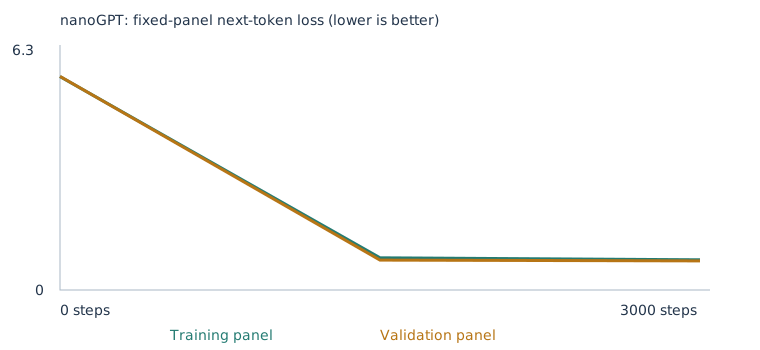
Loss is measured on fixed panels of at most 20 training and 20 held-out passages, averaged over non-padding next-token targets — small estimates, not full-corpus measurements. Both runs, every measured value (starter · expanded):
Starter corpus
| Step | Training panel | Validation panel |
|---|---|---|
| 0 | 4.9263 | 4.9275 |
| 1500 | 0.6821 | 0.7182 |
| 3000 | 0.6783 | 0.7061 |
Expanded corpus
| Step | Training panel | Validation panel |
|---|---|---|
| 0 | 5.7448 | 5.7518 |
| 1500 | 0.8658 | 0.8043 |
| 3000 | 0.8133 | 0.7842 |
The two runs’ losses are not comparable to each other: different corpus, different vocabulary, so a different task. Within each run, validation tracks training closely — expected, since the split shares templates, and therefore not evidence of generalisation.
Both curves are also nearly flat from step 1,500 to 3,000, which is what makes
exp3-longer’s failure to improve unsurprising in hindsight.
What it writes, untrained → halfway → trained
Same starting token, same sampling seed, expanded run (all saved samples):
Step 0 — untrained
short bird item update payment bird shoes kitten day two fish puppy falls i room every compared frozen an eats wet cold needs shoes question <BOS> hard another different car cats discussed
learned under plant beach our fast asked surgeon we traffic keeps after code old us <BOS> tool from another calm it ordered brand goat beach then soft cat salmon tired freezes seed
grows dry website needs checking becomes mango payment therapist bright keeps update big discussed small friend small plant a knows eat delivery bright metal important doctor falls person physician friend rises walk
route big turn tree and many uses early during hospital into item two steam metal delivery walked opposites teacher teacher water understand data puppies clean compared he square those teachers harvest slow
Step 1500 — halfway
the bird is heavy .
we learned about the important car during a discussion of travel .
we learned about the new tutor during a discussion of learning .
the new dentist was mentioned in the treatment report yesterday .
Step 3000 — trained
the team discussed the loan and the interest at the bank .
our store has a question about the local buyer and purchase .
we learned about the new shopper during a discussion of purchase .
a review of patient helped us understand the local surgeon .
At step 0 it is word salad drawn from a flat distribution. By halfway the sentence shapes are already right. Between halfway and the end the change is small — consistent with the loss curve, and a good reminder that a fluent-looking sample from a template corpus is not knowledge.
The interactive explorer
▶ Open it · source: viz/index.html
The chat box runs the model in your browser: 122,368 float32 parameters exported
from model.pt by viz/export_model.py, and a forward pass written in
plain JavaScript (viz/gpt.js) — embeddings, two blocks of causal 4-head attention
and GELU MLP, final LayerNorm, tied output projection. It checks itself on load against logits
captured from PyTorch at export time and reports the largest disagreement, which is 5.8e-6.
No server, no API, no canned answers.
Word graph, with the prediction drawn on it
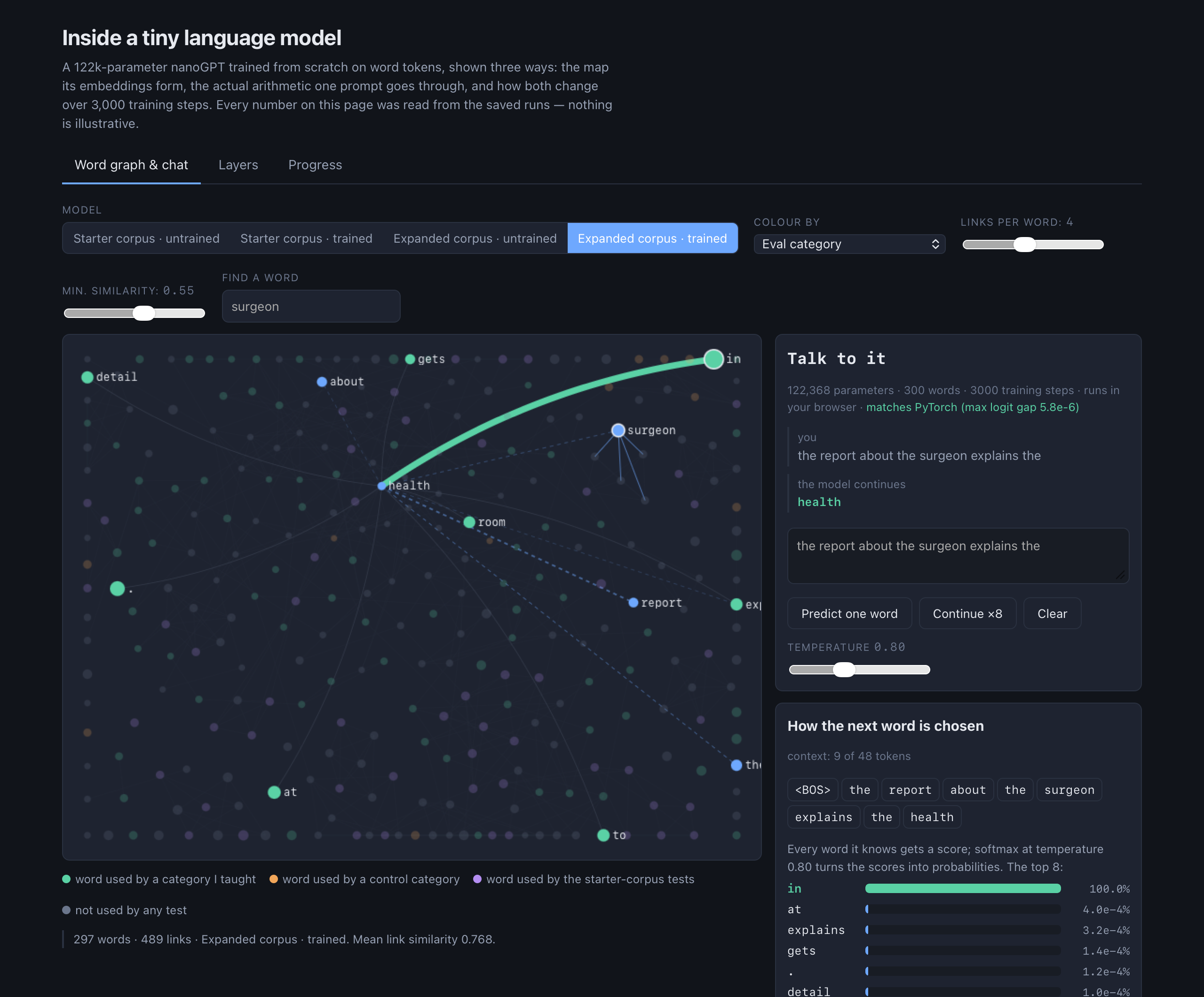
Every dot is one word in the vocabulary, sized by how often it was trained on. Two words are linked when each is among the other’s most similar vectors — cosine similarity across all 64 dimensions, not a 2-D projection — with the number of links and the similarity threshold under your control, so the map cannot be quietly cherry-picked. Nothing labelled these groups: the model only ever saw sentences and was only ever asked for the next word.
Type a prompt and the map becomes an explanation:
- the words of your prompt light up,
- dashed lines show what the last token actually attended to,
- solid rays fan out to the words it is considering next, thick in proportion to probability,
- the thickest ray leads to the word it picked.
The panel underneath shows the full distribution, the attention weights, and the dice roll that chose between them.
The same model before training
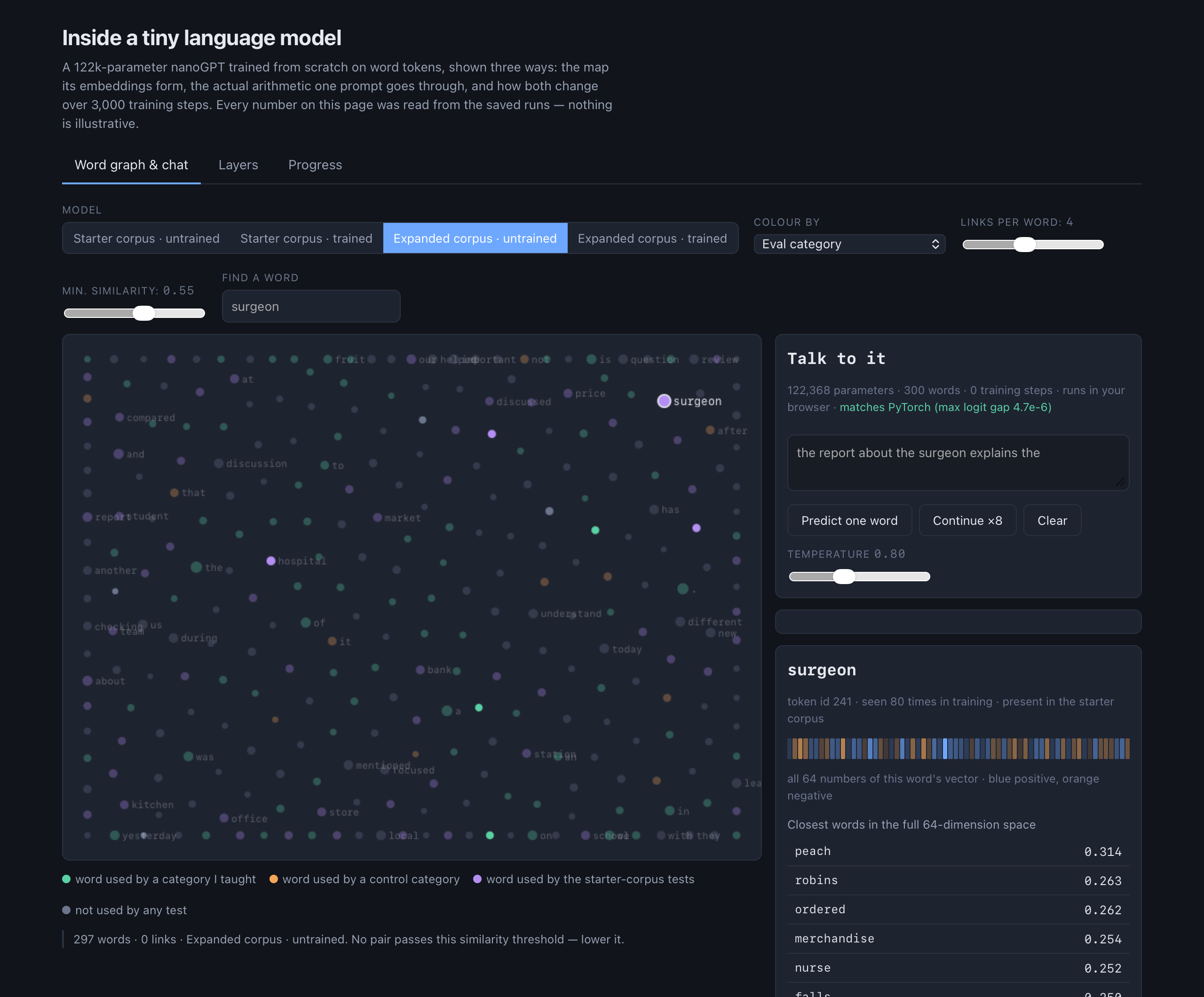
Same words, same threshold, weights at initialisation: zero links. The vectors are random draws, so no pair is meaningfully close to any other. This single comparison is the clearest thing in the project — training is what turns 300 rows of noise into a map.
Switch the model to Starter corpus · trained and type the opposite of hot is: three of the
five words arrive as <UNK>, and the model answers by ending the sentence (<EOS> at 90%).
That is what an unscorable eval case looks like from the inside.
Layers — the arithmetic for one prompt
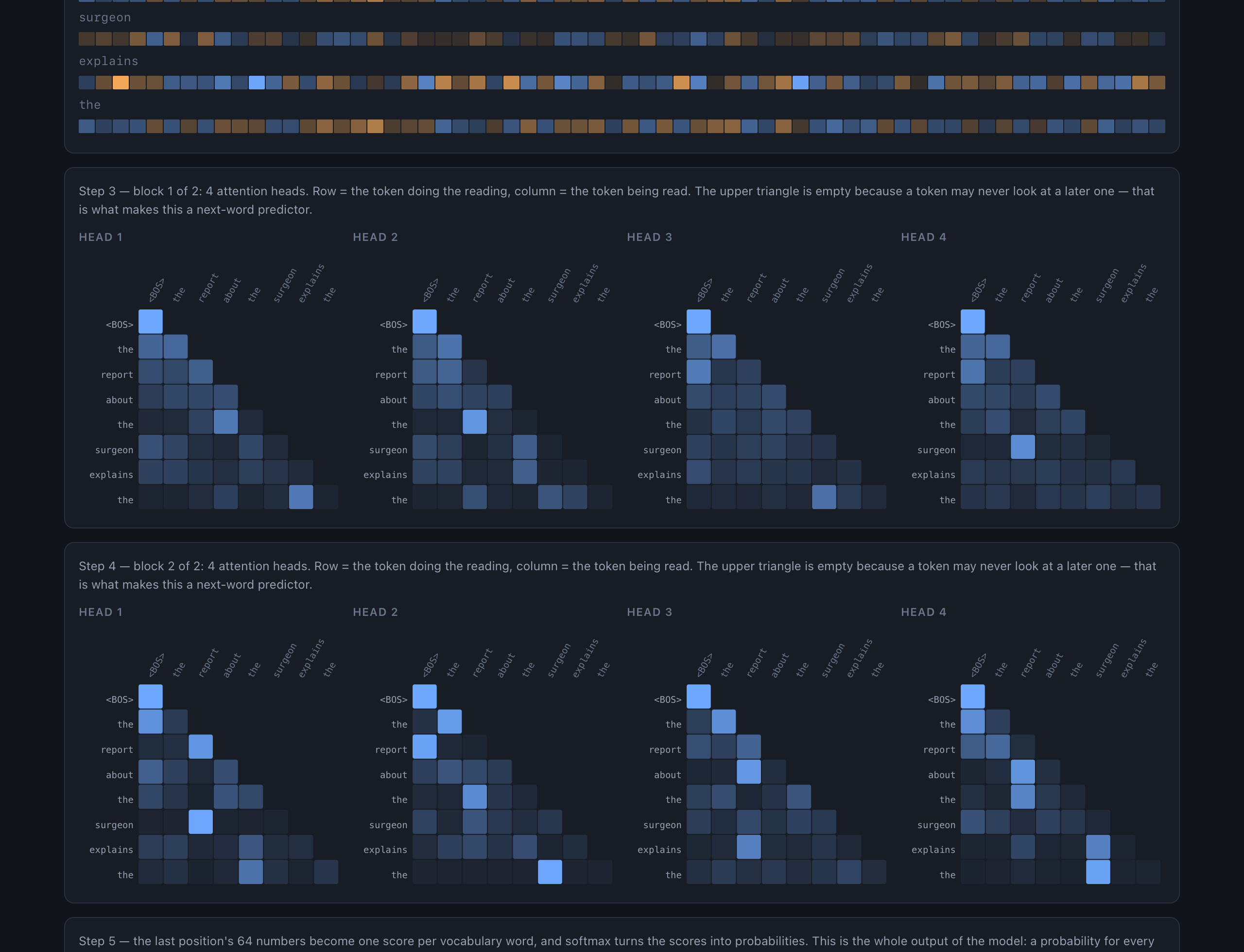
Tokens → row numbers → 64-number vectors → block 1’s four attention heads → block 2’s four → the final probability list. The heatmaps are real values from the saved weights, and they are triangles because a token may never read a later one.
Progress — the run itself
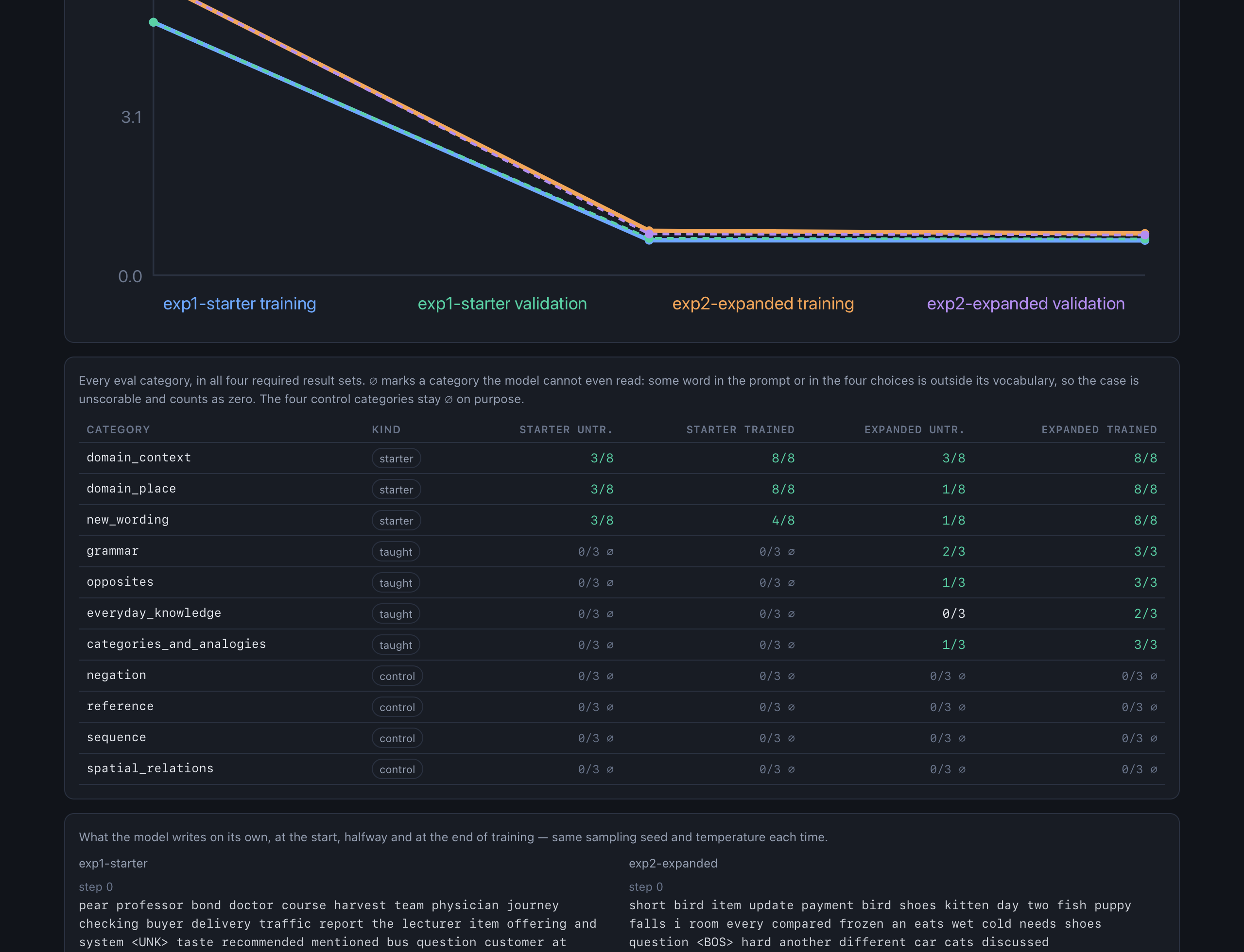
Loss curves, the samples at each milestone, every eval category across all four result sets, and an animation of the embedding table every 250 steps.
Those frames needed the embedding table during training, which the notebook does not save — and
I did not want to edit the notebook that produced the eval evidence. So
viz/replay_training.py rebuilds the run from the artefacts the
notebook already saved (split.json for the exact documents, tokenization.json for the exact
vocabulary, config.json for the settings) and repeats the identical loop with the same seeds.
It proves it is the same run rather than a lookalike: the freshly initialised weights must hash
to the saved model_untrained.pt, and the final weights must hash to the run’s recorded
model_sha256. Both match — 8b39337b5043ce19… — so the animation is
that exact training run, not a re-enactment.
What the explorer does not prove
A tidy cluster of medical words is a picture of co-occurrence in a small synthetic corpus,
not evidence of meaning. surgeon sits near physician because the same templates produced
both. The map would look just as convincing if the corpus were nonsense, as long as it were
consistent nonsense.
Chat with the model
Three interfaces, all driving the same trained weights
(8b39337b5043ce19…, 3,000 steps,
results/exp2-expanded/model.pt).
Terminal — the supplied chat.py
python chat.py --model results/exp2-expanded/model.pt --transcript my-chat.json
Recorded session: terminal_session.txt ·
transcript: terminal_transcript.json
| Prompt | Reply | Words it could not read |
|---|---|---|
the report about the surgeon explains the |
health in detail . | — |
the opposite of empty is |
two . | — |
a robin is a bird . a salmon is a |
fish . | — |
ava did not buy tea . she bought milk . ava bought |
about the different investment and the different program was walking to the return report yesterday . | ava, bought, buy, did, milk, tea |
the quarterly ebitda margin compressed because freight costs rose sharply |
about the different item . | because, compressed, costs, ebitda, freight, margin, quarterly, rose, sharply |
Web — chat_web.py, loading model.pt directly
python chat_web.py --model results/exp2-expanded/model.pt
# open http://127.0.0.1:8000
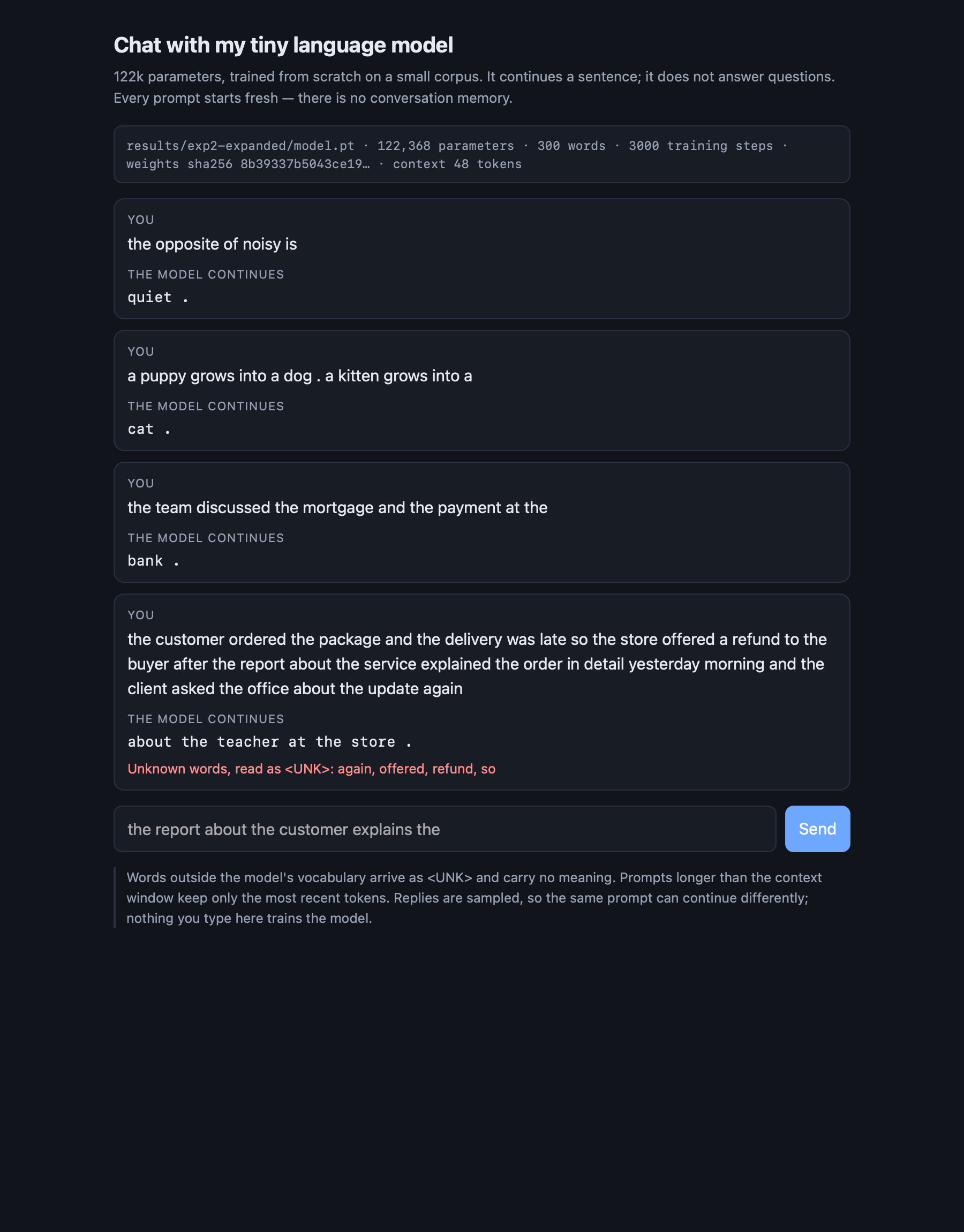
Transcript: web_transcript.json
| Prompt | Reply | Words it could not read |
|---|---|---|
the opposite of noisy is |
short . | — |
a puppy grows into a dog . a kitten grows into a |
cat . | — |
the team discussed the mortgage and the payment at the |
bank . | — |
the customer ordered the package and the delivery was late s… |
. | offered, refund, so |
the opposite of noisy is |
quiet . | — |
a puppy grows into a dog . a kitten grows into a |
cat . | — |
the team discussed the mortgage and the payment at the |
bank . | — |
the customer ordered the package and the delivery was late s… |
about the teacher at the store . | again, offered, refund, so |
In the explorer
The chat box in the explorer needs no server at all — see above.
What these interactions show
- It continues text; it does not answer.
a robin is a bird . a salmon is a→fish .is the best case, and it is still just continuation. - The multiple-choice score is not the chat. The exam records
the opposite of empty is→ full as correct, yet the terminal reply to the same prompt wastwo .— sampling at temperature 0.8 from a distribution whose top word is right but not dominant. - Unknown words are invisible to it, not approximated. The finance prompt lost nine words to
<UNK>; the negation prompt lost six, including the two the question turns on, and the reply is unrelated text. - Every prompt starts fresh. There is no conversation memory, the context is 48 tokens, and nothing typed anywhere retrains the model or enters the corpus.
Reproducing everything
python3.12 -m venv .venv && source .venv/bin/activate
pip install -r requirements.txt numpy

python make_corpus.py                  # regenerate the teaching corpus (checks leakage)
python corpus_sources/make_pdf.py      # re-render the PDF and verify extraction

python run_experiment.py --name exp1-starter  --corpus-folder corpus_starter
python run_experiment.py --name exp2-expanded --corpus-folder corpus
run_experiment.py patches only the settings cell of
notebook_template.ipynb, executes the notebook with outputs intact,
and copies the new llm_runs/ folder into results/. The starter run points at
corpus_starter/, which holds nothing but a README, so the classroom corpus is
used alone and the run stays reproducible from a clone.
Rerun the exam on the saved weights, without the notebook:
python run_evals.py --model results/exp2-expanded/model.pt           --output /tmp/recheck-final
python run_evals.py --model results/exp2-expanded/model_untrained.pt --output /tmp/recheck-untrained --stage untrained
Rebuild the explorer’s data and this README:
python viz/export_viz.py && python viz/export_model.py
python viz/replay_training.py --run results/exp2-expanded --every 250
python build_readme.py
python -m http.server 8777    # then open http://127.0.0.1:8777/viz/
Checks: python -m unittest test_language_evals test_corpus (the starter’s own separation
tests) and python make_corpus.py --check (leakage and vocabulary-coverage report).
Hardware: macOS-26.6.2-arm64-arm-64bit, CPU, PyTorch 2.14.0. Training took 6.7s (starter) and 7.3s (expanded) for 3,000 completed steps each; neither run was interrupted.
Limitations and the next experiment
- This is a development benchmark, not a test. I read the results while choosing what to teach. The taught-category result is strong, but “does the model generalise” needs cases that never influenced a decision.
- The held-out split does not test generalisation either — it splits passages, not source files, so both sides share templates.
- Three seeds is a small sample. It is enough to show 0/12 → 11–12/12 is not noise; it is not enough to resolve the 4/8 → 8/8 transfer difference, which is why I do not claim it.
- Nothing here is understanding. 11/12 on the taught categories means the model ranks one word above three others after a pattern it was drilled on. The free continuations in the chat section are the honest picture of what it can actually produce.
- The corpus is synthetic and narrow. Every sentence follows a handful of templates, so both the loss and the clean clusters in the explorer are easier than real text would be.
Next experiment, one change, data only: fix the water freezes into collision. Remove
ice melts into water . and add sentences that put ice after into in frames unrelated to the
test prompt (the cold turns the puddle into ice ., the machine makes water into ice .), keep
steps, learning rate and seed identical, and rerun all 48 cases at the same three seeds. I expect
lang_43 to flip and nothing else to move — and if other categories move too, the corpus is
doing something I have not accounted for. That is a one-variable test of the claim I am making in
this README: that what this model knows is exactly what its corpus taught it.
How this was built
The course’s own assignment brief includes a starter prompt for working through this project with an AI assistant, and that is how it was built: I worked through it with Claude (Claude Code), which wrote the corpus generator, the experiment runner, the explorer and its in-browser model, the separation audit and the generator that produces this README. What I directed and decided: the experimental design (four taught categories against four held back as a control, one variable between runs, identical steps and learning rate), the choice to test the corpus-extension claim across three random seeds before believing it, and what this document may and may not claim.
The predictions in PREDICTION.md were committed to git before the first
training run, so the record of what was expected precedes the results. Every number in this
README is read from the saved run artefacts by build_readme.py rather than
typed in, which is why the places where the prediction was wrong are still visible.
nanoGPT is MIT-licensed by Andrej Karpathy (NANOGPT_LICENSE). The starter
notebook, eval suite and runner come from the course sample project. Everything else in this
repository was produced for Class 4 of Fundamentals of Agentic AI.